Anna Hughes · 22 September 2026
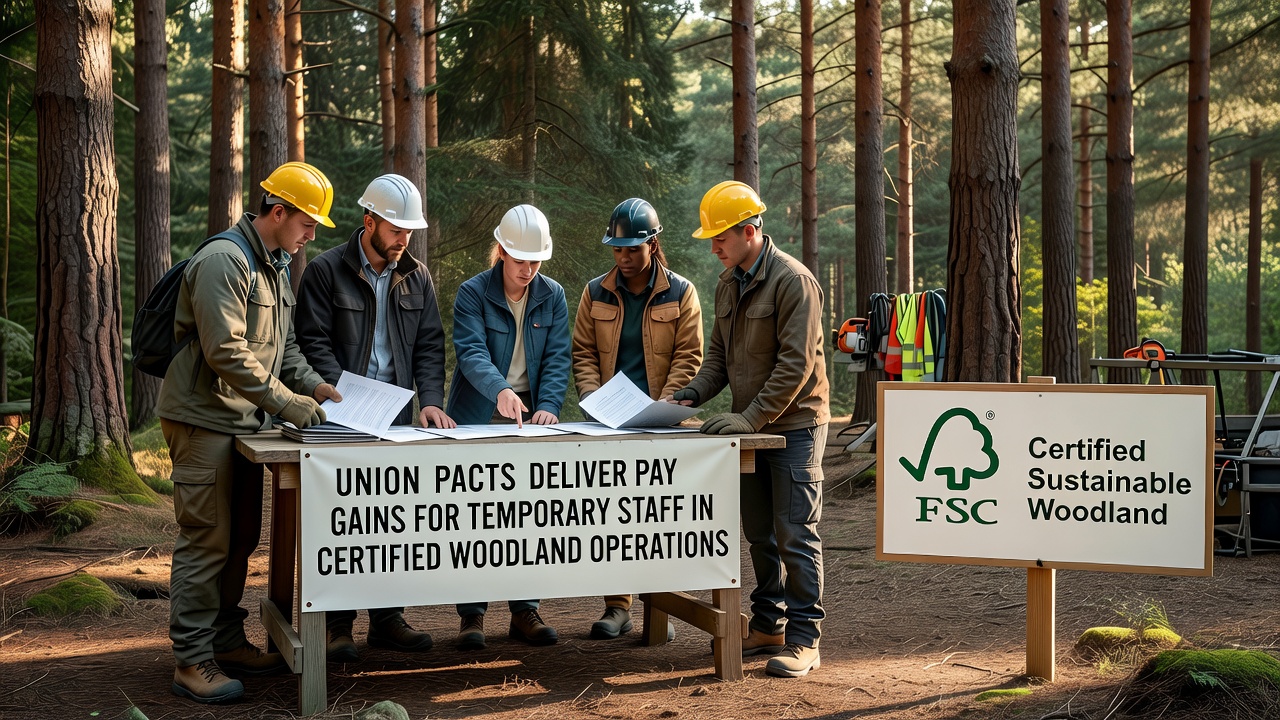
Union Pacts Deliver Pay Gains for Temporary Staff in Certified Woodland Operations
Union negotiations have produced measurable wage increases for temporary employees across certified woodland operations in multiple regions, and these changes took effect following agreements finalized in September 2026. Certified operations, which adhere to standards set by organizations such as the Forest Stewardship Council and the Programme for the Endorsement of Forest Certification, employ large numbers of seasonal and contract workers during planting, thinning, and harvesting cycles. Data from labor monitoring groups shows that pacts covering these roles delivered base pay adjustments ranging from 12 to 18 percent in participating European and North American sites, with additional provisions for overtime and safety equipment allowances.
Background on Temporary Roles in Certified Forestry
Temporary staff perform essential tasks that align with certification requirements for sustainable harvesting and habitat protection, yet these workers have historically received lower compensation than permanent crews because contracts often last only three to nine months. Researchers tracking employment patterns note that turnover rates in these positions reached 45 percent annually before recent agreements, and that figure contributed to inconsistent training outcomes on sites managed under strict environmental protocols. Certified woodland operators must document compliance with labor standards as part of audit processes, which created an opening for unions to tie wage demands to certification maintenance.
Observers tracking the sector point out that temporary positions account for roughly 35 percent of total labor hours in FSC-certified European forests and 28 percent in comparable Canadian operations. These percentages rise during peak seasons when operators expand crews to meet timber supply contracts, and the influx of short-term hires has drawn attention from labor organizations seeking to standardize conditions across the supply chain.
Details of the 2026 Union Agreements
Agreements reached in September 2026 covered operations in Germany, Sweden, and parts of British Columbia, where union representatives secured clauses that extend minimum wage floors to all contract workers regardless of employment duration. The pacts also introduced portability for accrued benefits, allowing temporary staff to carry health and pension contributions between sites operated by the same certification holders. Figures released by the European Forest Institute indicate that participating companies reported a 14 percent average increase in hourly rates for seasonal crews, while productivity metrics remained stable because operators absorbed costs through efficiency gains in equipment scheduling.
What's notable is how these pacts integrated with existing certification audits, since labor compliance now factors more heavily into annual reviews. Operators must submit payroll records showing adherence to the new scales, and failure to meet targets can trigger corrective action plans that delay certification renewal. This linkage has prompted several mid-sized woodland management firms to adjust recruitment practices, shifting some seasonal contracts toward longer-term arrangements that reduce administrative overhead.

Regional Variations and Implementation Patterns
Implementation differs by jurisdiction. In EU member states the agreements build on existing directives that require equal treatment for temporary and permanent workers after a defined period, whereas Canadian provinces rely more on provincial labor codes that unions leveraged during bargaining rounds. Data compiled by Statistics Canada shows temporary forestry wages rose 16 percent in certified districts between September 2025 and September 2026, outpacing non-certified areas where increases averaged 9 percent over the same interval.
One study conducted by researchers at the University of British Columbia examined payroll data from 47 certified sites and found that the pay adjustments reduced recruitment costs because retention improved by 22 percent. Operators reported fewer repeat training sessions for new hires, which lowered both direct expenses and indirect downtime associated with onboarding. These outcomes align with broader patterns observed by the International Labour Organization in its 2026 forestry sector review, where similar wage structures correlated with lower incident rates during high-risk activities such as chainsaw operation and cable yarding.
Effects on Operations and Certification Maintenance
Certified woodland managers have adjusted budgeting models to accommodate the wage increases while preserving margins on timber sales. Some have offset costs by extending harvest windows through better coordination with buyers, which reduces the need for rushed seasonal crews. Others have invested in mechanized equipment that requires fewer operators overall, although certification standards still mandate minimum human oversight for biodiversity monitoring tasks.
Payment structures now include performance bonuses tied to safety records and compliance documentation, features that were previously limited to permanent staff. Union representatives report that temporary workers have begun participating more actively in site-level safety committees as a result, contributing observations that feed into the continuous improvement requirements embedded in certification frameworks.
Conclusion
Union pacts finalized in September 2026 have established new compensation benchmarks for temporary staff in certified woodland operations, and the resulting pay gains appear in payroll records across multiple countries. These changes intersect with certification requirements that emphasize both environmental and social criteria, creating a feedback loop that encourages operators to maintain consistent labor standards. Continued monitoring by labor statistics agencies and forestry research bodies will determine whether the patterns observed in 2026 persist or evolve in subsequent bargaining cycles.